

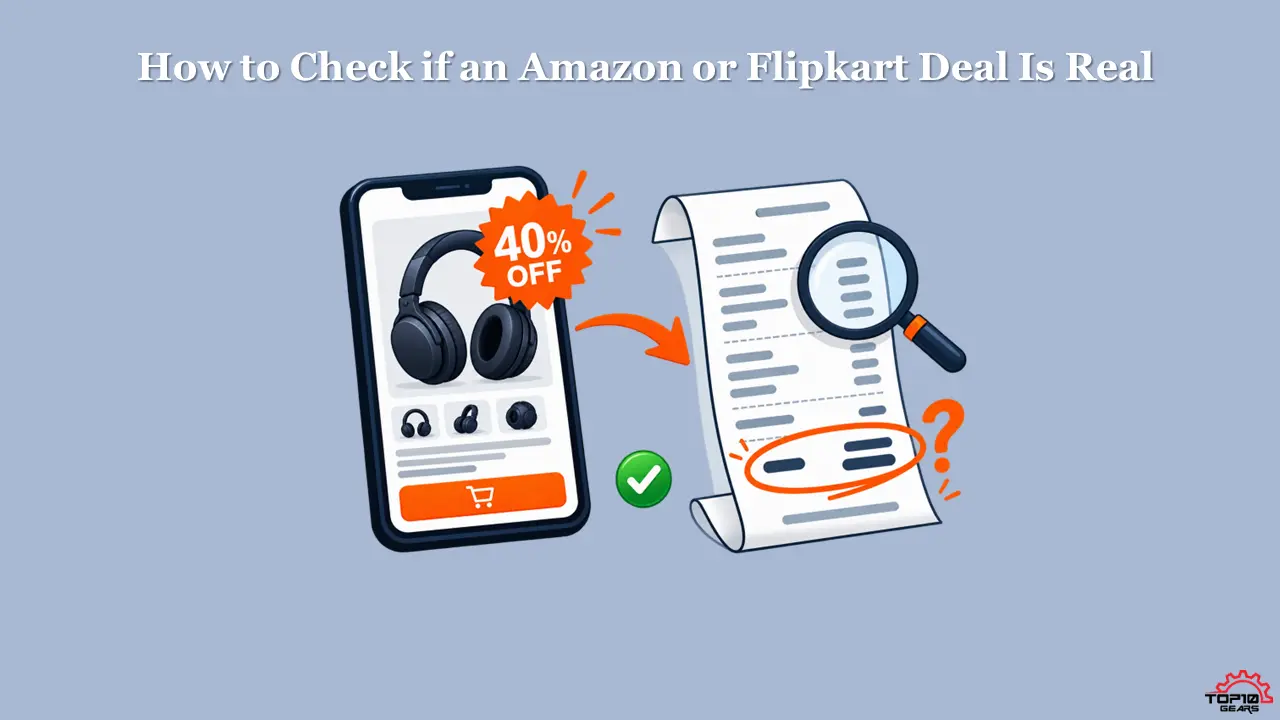
A phone you’ve been watching for weeks drops to “65% off”, and a bank banner says you’ll save another ₹4,000 on top. It looks like the deal of the year, and sometimes it is.
Just as often, the “original” price is an MRP nobody paid, or the discount only applies to the 6GB model when you wanted the 8GB. The bank offer can disappoint too. Read the terms and you may find a cap that turns that ₹4,000 into a few hundred rupees.
A deal is real when:
- The price is at or below what the product has sold for in recent weeks, not just below MRP.
- It’s the exact variant you want.
- What you finally pay, after the bank offer, EMI charges and exchange value, still beats other stores.
- You’re happy with the seller’s return and warranty terms.
That’s a lot to check with a sale timer running, so we’ve split it into the five checks below. Do them in order: if a deal fails the first one, there’s no point doing the other four.
You’ll want these sorted before 8 October 2026, when Amazon’s Great Indian Festival starts. Flipkart’s Big Billion Days opens to everyone on 9 October, with early access from 8 October (About Amazon, Flipkart Big Billion Days page, Flipkart Stories; checked 27 Sep 2026).
- How to check if an Amazon or Flipkart deal is real: 5 checks at a glance
- Check 1: Compare the price with its recent selling price, not MRP
- Check 2: Make sure it’s the exact variant and listing
- Check 3: Work out the effective price after bank offers, no-cost EMI and Exchange
- Worked example: one ₹30,000 product, three ways to pay (HYPOTHETICAL)
- Check 4: Check the seller, warranty and return terms
- Check 5: Compare the price across stores before you pay
- Sale tricks to recognise, and where to complain in India
- 60-second checklist before you pay
- Before the sale: know what specs you need
- Frequently Asked Questions
- Sources and references
How to check if an Amazon or Flipkart deal is real: 5 checks at a glance
Keep this table open while you shop. Each check has its own section below with the details.
| Check | What you’re looking for |
|---|---|
| 1. Price vs recent selling price | At or below the 30-day low? |
| 2. Exact variant and listing | Same model, RAM/storage, colour and seller |
| 3. Effective price | What you pay after offers, EMI costs, exchange |
| 4. Seller, warranty and returns | Who sells it; return or replacement window |
| 5. Other stores | Same variant’s effective price elsewhere |
We based this guide on Amazon and Flipkart help pages and sale announcements, bank and RBI terms, government rules, and each price tracker’s own website. We didn’t buy any products or test the trackers ourselves.
Check 1: Compare the price with its recent selling price, not MRP
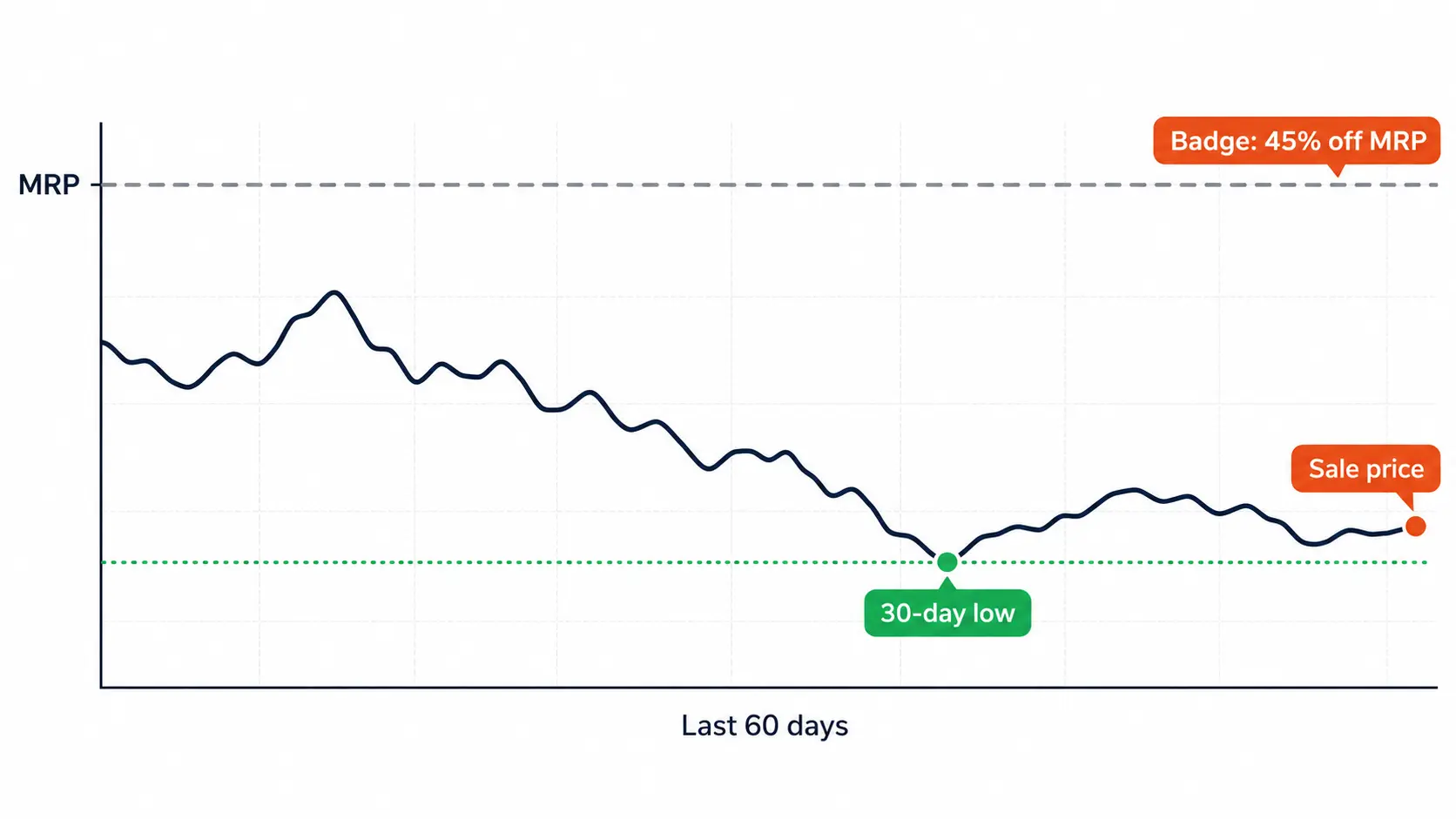
A discount badge is usually measured from MRP, which says nothing about what the product actually sold for last month. One tracker, pricehistoryapp.com, notes on its own site that discount badges are worked out from MRP rather than from the recent selling price.
Compare instead with the lowest and typical price over roughly the last 30 days. That is the same yardstick the government has now written into its rules (TaxGuru).
What the new e-commerce rules change, and when
The Consumer Protection (E-Commerce) (Amendment) Rules, 2026 were notified on 9 September 2026 (G.S.R. 789(E)) and come into force on 1 January 2027 (TaxGuru, SCC Online).
From that date, a platform or seller announcing a price reduction will have to show the “prior price” next to the reduced price. Prior price means the lowest price of the product in the 30 days before the price cut was announced (TaxGuru, SCC Online).
These rules do not apply to the October 2026 sales. Until then, find the prior price yourself (next section).
How to check price history on Amazon and Flipkart
- Copy the product link from the Amazon or Flipkart app or website.
- Paste it into a tracker’s website, or open the product page with the tracker’s browser extension installed.
- Read the lowest, highest and typical price over the period shown. Compare today’s price with the 30-day low, and set a price-drop alert if the tool offers one.
BuyHatke’s site describes a shortcut: add “buyhatke.com/” in front of the product link.
Tracker tools by store coverage (alphabetical, not ranked)
We picked these seven because each one says on its own site that it tracks Amazon.in, Flipkart or both. The groups show which stores a tool covers, and inside each group they’re in alphabetical order. We don’t make money from any of these links, and no tool paid to be on this list.
Table 1: Price trackers by store coverage Per each tool’s own site or Chrome Web Store listing, checked 27 Sep 2026
| Tool | Other stores (tool’s own claim) | Available as | Cost (tool’s own claim) | Price alerts | Says chart includes bank offers/coupons? |
|---|---|---|---|---|---|
| Amazon only | |||||
| Keepa | Other Amazon country sites | Chrome extension | Free to install (listing) | Price drop and back in stock | Not stated |
| Amazon.in + Flipkart | |||||
| BuyHatke | Many stores | Web; link-prefix method | Not stated | Alerts section on site | Not stated |
| Flipshope | Ajio, Croma, JioMart, Meesho, Myntra, Pepperfry, Reliance Digital, Tata Cliq | Extension, app, web | Free | Yes (account needed for custom alerts) | Not stated |
| Price History (pricehistoryapp.com) | Myntra, Ajio, Nykaa, Croma and others | Extension, iOS, Android | Free, no account | Push, email, Telegram | Not stated |
| Price History (pricehistory.app) | Says tracking is enabled only for Amazon and Flipkart | Web, apps, extension, bookmarklet | Free | Price drop, back in stock and more, via email, SMS, app or Telegram | Shows a separate “Offer Price” line for coupons and deals (Amazon India only); bank offers not stated |
| PriceBefore | “& more” | Web, extension | Free | Email target-price alerts (free account) | Not stated |
| PriceDiff | Myntra, Ajio | Web (paste link) | Free, no sign-up | Not mentioned | Not stated |
The two “Price History” entries are separate websites with similar names.
What price trackers don’t tell you
None of these tools says on its own site that its charts include bank instant discounts or card EMI costs (as of 27 Sep 2026). On coupons, pricehistory.app says its chart adds a separate “Offer Price” line for coupons and deals, for Amazon India only.
Otherwise the chart shows the listed selling price. You still have to work out what you’d actually pay, which is Check 3.
Check 2: Make sure it’s the exact variant and listing
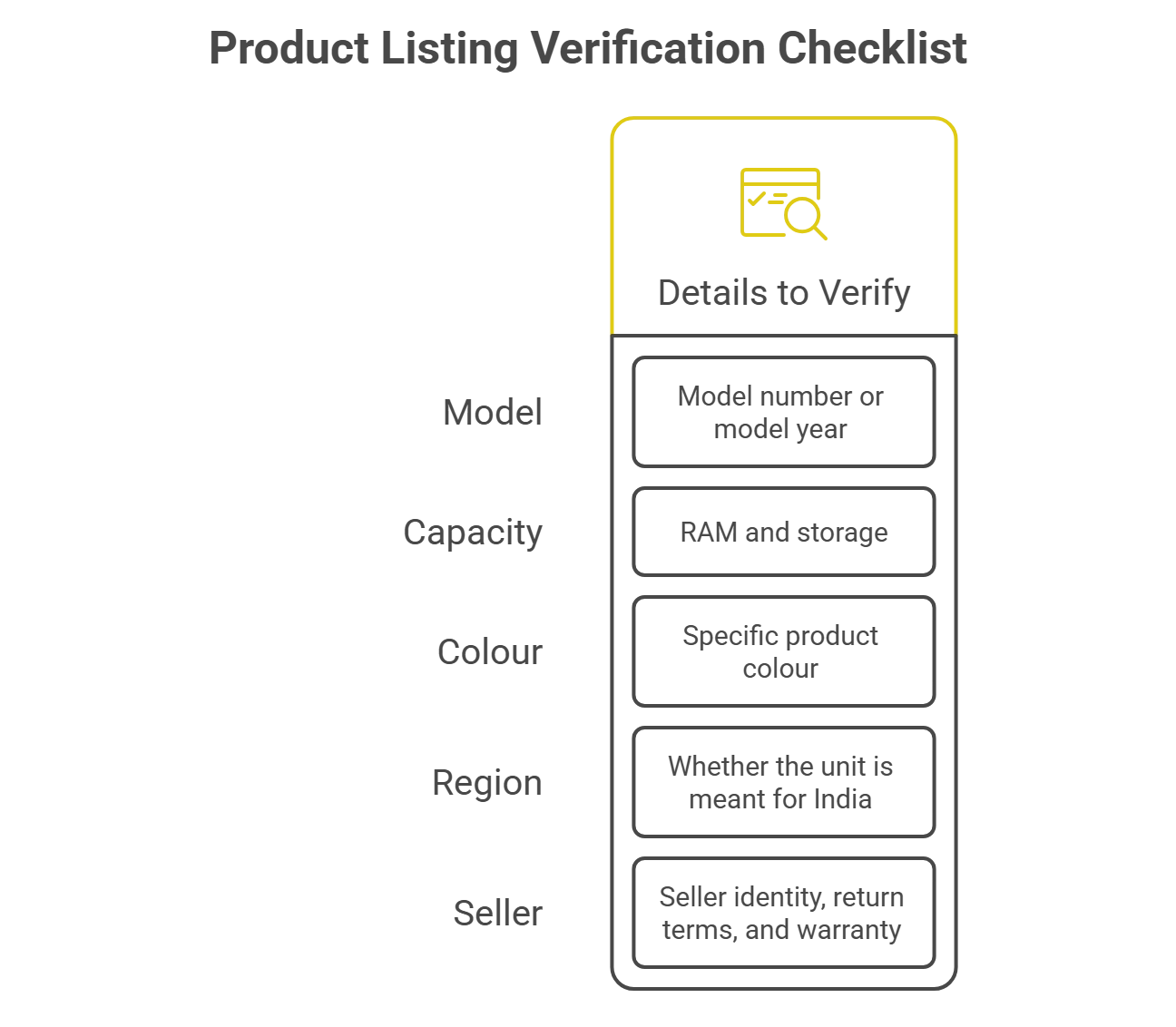
Before you trust a “lowest ever” price, match these against the listing whose history you checked:
- The model number or model year. Phones and laptops often keep a name across generations.
- RAM and storage. An 8 GB/256 GB phone and a 12 GB/256 GB phone are different products; the same goes for laptops.
- The colour, since some colours are priced differently.
- Where the listing shows it, whether the unit is meant for India.
- The seller. The same product from a different seller can come with a different price, return terms and warranty handling (Check 4).
At checkout, if the advertised item suddenly shows as unavailable and a pricier alternative is pushed, that fits what the Central Consumer Protection Authority (CCPA) calls “bait and switch” in its dark-pattern guidelines (CCPA guidelines, PDF via Trilegal).
Check 3: Work out the effective price after bank offers, no-cost EMI and Exchange
The number on the product page is often not what leaves your account. Use this formula:
Effective price = listed price
- − bank instant discount (the lower of % × price and the cap, and only if the minimum order is met and your payment type qualifies)
- − the exchange value you actually receive
- + EMI extras (GST on interest + processing fee + GST on that fee)
- − cashback you actually receive later (count it separately)
Bank offers: read the cap, minimum order and payment type
The offer T&C usually sets the percentage, a maximum discount (on expensive items the cap often matters more than the percentage), a minimum order value, which cards qualify, whether EMI counts, and per-card limits across the sale.
For the 2026 sales, Amazon’s headline offer is a 10% instant discount on SBI credit and debit cards and EMI transactions (About Amazon). Flipkart’s sale page lists an instant discount of “up to 10%” on eligible Axis Bank and ICICI Bank card transactions, with terms and conditions applying (Flipkart Big Billion Days page).
Neither official sale page showed a cap or minimum order value (checked 27 Sep 2026), so open the offer T&C before you pay.
No-cost EMI: what it actually costs
No-cost EMI isn’t interest-free credit. Amazon’s help page explains that the interest has “already been adjusted from the price of the order”, so your instalments add up to the product price (Amazon.in EMI help). The interest is still charged; you get a discount equal to it.
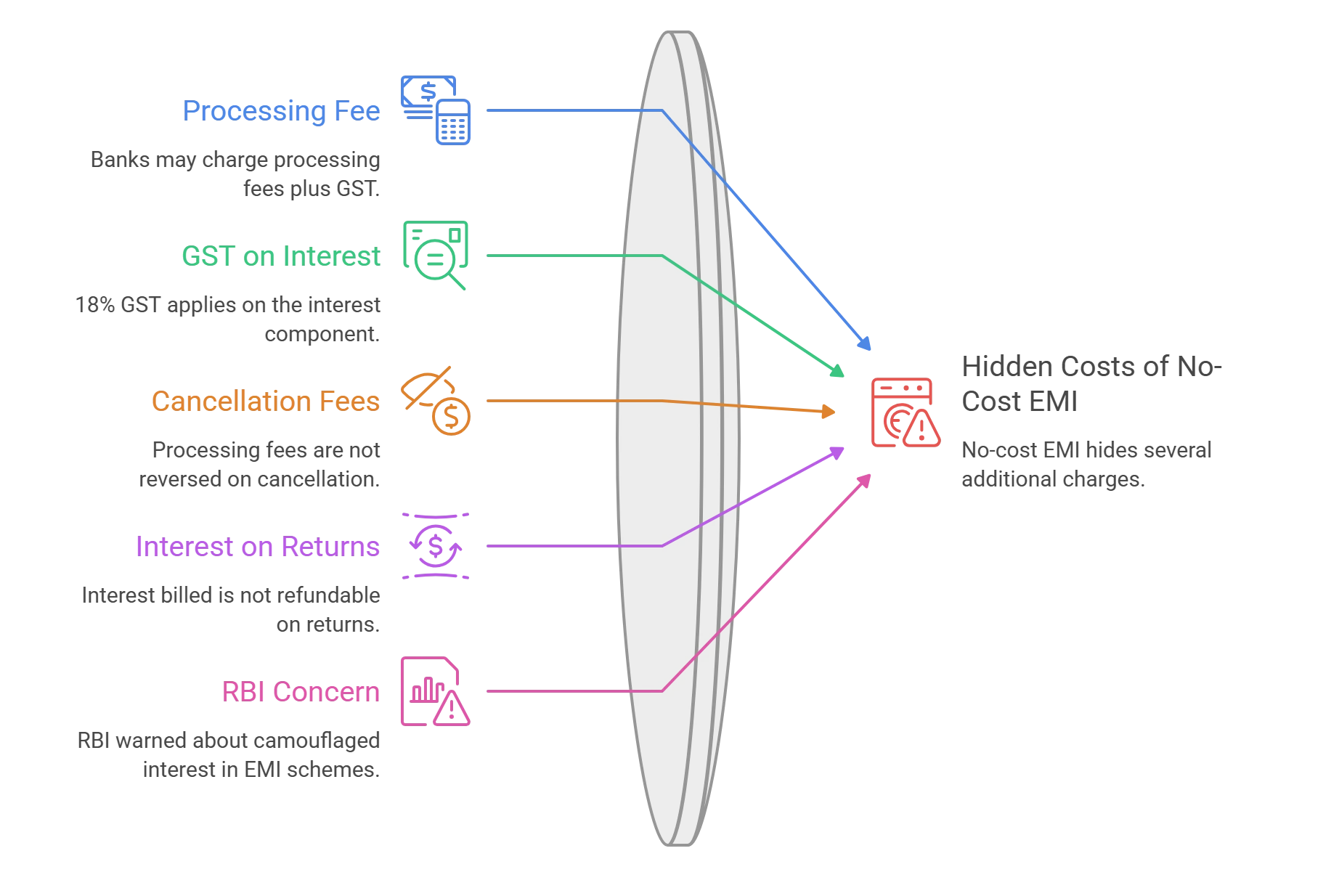
The extras sit on top:
- A processing fee plus GST. Amazon says it doesn’t charge a fee for EMI orders, but “your bank may charge a processing fee + GST” (Amazon.in EMI help). Flipkart says it charges no processing fee for its EMI option, and GST may be levied by the bank (Flipkart EMI T&C). Fees vary by bank, card and merchant, so check the payment page.
- GST on the interest. HDFC Bank says 18% GST applies on the interest component (HDFC Bank’s EMI terms).
- Fees that stay if you cancel. HDFC Bank says the processing fee is not reversed on cancellation or pre-closure (HDFC Bank’s EMI terms).
- Interest after a return. Flipkart’s EMI T&C says “interest already billed in a particular transaction is not refundable under any circumstances” (Flipkart EMI T&C). Ask your bank how a cancellation affects the EMI (Flipkart EMI T&C).
The RBI raised a related concern in 2013. Its circular RBI/2013-14/292 (17 September 2013) said that in “zero percent” EMI schemes on credit card outstandings, “the interest element is often camouflaged and passed on to customer in the form of processing fee” (RBI circular).
Exchange offers: the “up to” value is a ceiling
On Amazon, the Exchange Offer FAQ says you enter your old device’s details and an exchange value is applied as a discount at checkout (Amazon.in Exchange FAQ). At delivery, the associate checks the device against what you declared.
A phone, laptop or TV must be in working condition, with a screen free of scratches, cracks, discolouration, spots, lines or dead pixels (Amazon.in Exchange FAQ).

If it fails the checks, Amazon says you can still take the new product by paying the exchange discount amount, and your old device isn’t picked up. Amazon also says an exchange fee may be added to the order total (Amazon.in Exchange FAQ and T&C).
On Flipkart, the exchange page says completely broken or non-working appliances can’t be exchanged, and that the price depends on the condition and demand of the old device (Flipkart exchange page).
Before pickup, back up and delete your data, sign out of your iCloud or Google account and remove screen locks.
Worked example: one ₹30,000 product, three ways to pay (HYPOTHETICAL)
Illustration with made-up numbers. This is not a real offer, product or bank term.
Assumptions (all hypothetical, round numbers):
- Listed price: ₹30,000 for the exact variant you want.
- Bank offer: 10% instant discount, capped at ₹1,500, minimum order ₹5,000; in this example it applies to full payment only.
- No-cost EMI: 6 months, bank interest assumed at 15% a year, processing fee assumed at ₹199. GST at 18% on the interest and on the fee (only the 18% rate is sourced, per HDFC Bank’s EMI terms).
- Exchange: the listing shows “up to ₹5,000”. For your phone’s model and condition, the exchange value at checkout works out to ₹3,000.
Route A is full payment with the card offer: 10% of ₹30,000 is ₹3,000, but the cap is ₹1,500. In Route B, about ₹1,270 of interest is built into the six instalments and given back upfront as the “no-cost” discount, but you still pay about ₹229 GST on it plus about ₹235 for the fee with GST. Route C is Route A plus the ₹3,000 exchange value, not the “up to ₹5,000” headline.
Table 2: Worked example with made-up numbers Hypothetical, not a real offer
| Route | Listed price (₹) | Bank instant discount (₹) | Exchange value (₹) | EMI extras: GST on interest + fee incl. GST (₹) | You pay (₹) |
|---|---|---|---|---|---|
| A. Full payment + card offer | 30,000 | −1,500 | 0 | 0 | 28,500 |
| B. No-cost EMI, no instant discount | 30,000 | 0 | 0 | +464 (229 + 235) | ≈30,464 |
| C. Route A + exchange | 30,000 | −1,500 | −3,000 | 0 | 25,500 |
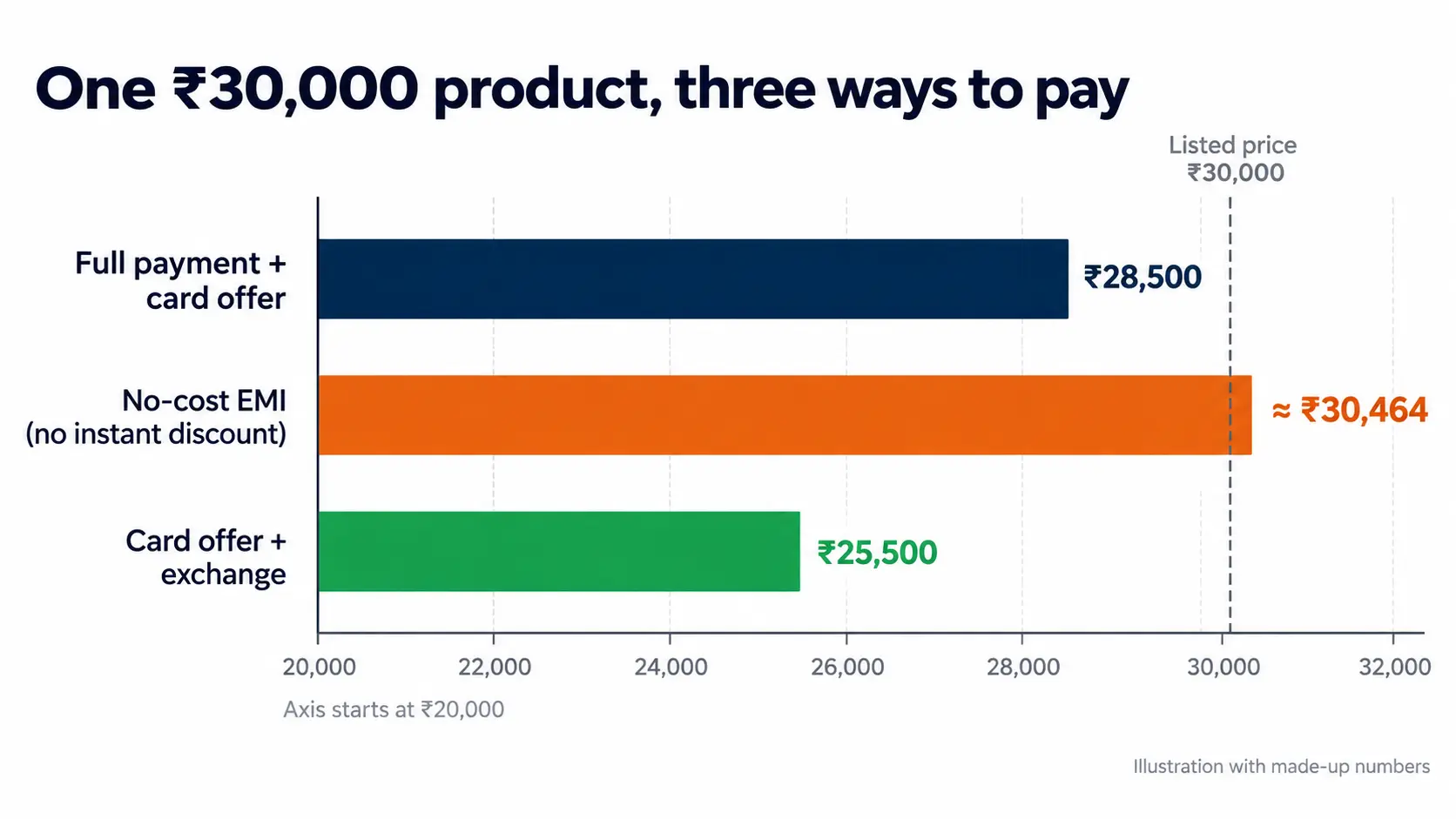
In this illustration, EMI costs about ₹1,964 more than paying in full, and the exchange headline overstates the saving by ₹2,000. Your numbers will differ. EMI can still suit you if spreading the cost matters more than the extra amount.
Route B maths: monthly rate 1.25%, 6 instalments; loan ≈ ₹28,730, interest ≈ ₹1,270.
Check 4: Check the seller, warranty and return terms
On Amazon, the product page shows “Sold by” and “Ships from”. Amazon’s help page says seller-fulfilled items read “Sold by (seller) and Ships from (seller)” (Amazon.in seller-fulfilled orders help). Tap the seller’s name to see their profile, and read the return policy shown on the listing before you pay.
Amazon says “Fulfilled by Amazon” means a third-party seller sells it, but Amazon stores, packs and ships it (Amazon.in Fulfilled by Amazon help). Seller-fulfilled orders are covered by Amazon’s A-to-z Guarantee for missing or incorrect orders (Amazon.in seller-fulfilled orders help).
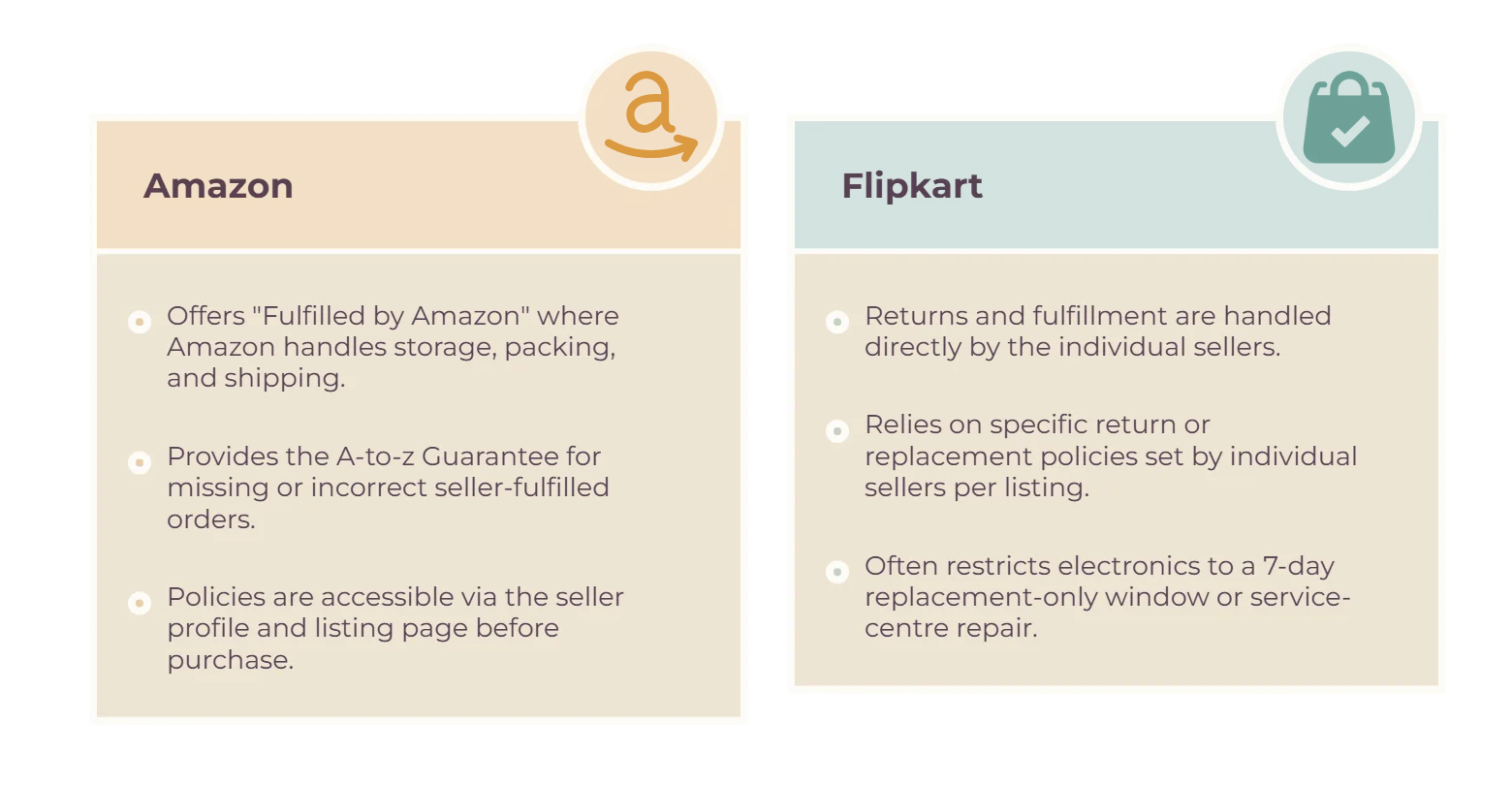
On Flipkart, returns are offered by the sellers, and the return or replacement policy on the product page overrides the general policy. Many electronics are replacement-only within 7 days if they arrive defective or damaged. Some premium brands are service-centre replacement or repair only (Flipkart return policy).
Check the listing’s warranty details too, and once the product arrives, use the return window. Our list of things to check after your new laptop arrives helps you catch problems in time.
Check 5: Compare the price across stores before you pay
Check the same variant on the other big platform, and on brand or electronics retail stores. Compare the effective price from Check 3 and the return terms from Check 4, not the headline number.
Multi-store trackers can save time. Per their own sites, Flipshope also covers Croma, Reliance Digital, Tata Cliq and others, and PriceDiff covers Myntra and Ajio. For an AC, compare across brands too (see AC brands compared).
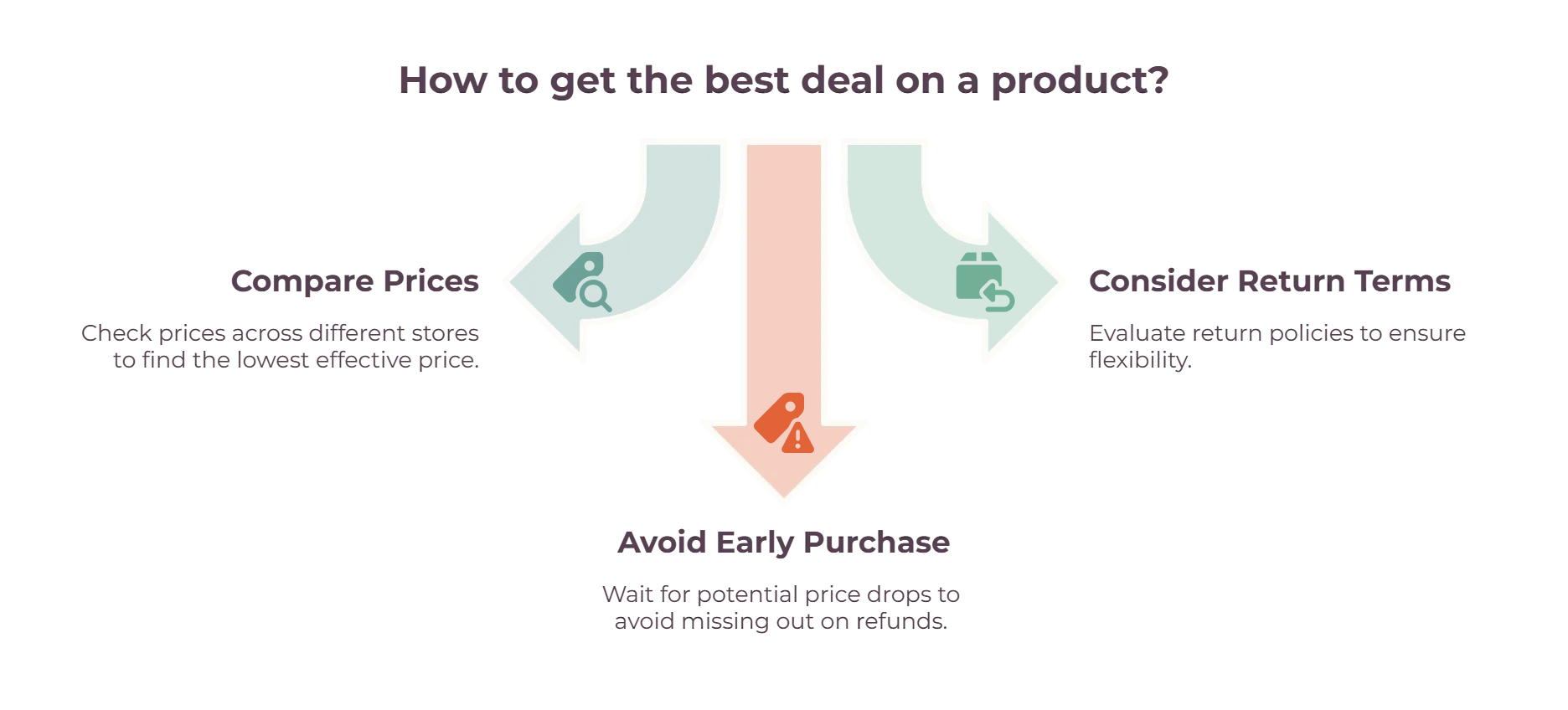
Don’t buy early counting on a refund if the price falls later. Neither Amazon’s nor Flipkart’s India help pages, as checked on 27 Sep 2026, describe a general price-drop refund.
Sale tricks to recognise, and where to complain in India
Your rights as a buyer
The CCPA issued its Guidelines for Prevention and Regulation of Dark Patterns on 30 November 2023. They list 13 dark patterns and treat them as unfair trade practices under the Consumer Protection Act, 2019 (CCPA guidelines, PDF via Trilegal).
Four patterns you’ll meet during sales
- False urgency. Falsely claiming or implying that stock or time is running out, to rush you.
- Drip pricing. Extra charges revealed only later, or after you confirm the purchase.
- Bait and switch. Advertising one thing, then offering something else, such as a pricier alternative.
- Basket sneaking. Adding extras to your cart without consent (disclosed delivery, gift-wrap and tax charges excluded).
How to complain
- National Consumer Helpline: call 1915 (8 AM to 8 PM), or WhatsApp/SMS 8800001915 (National Consumer Helpline).
- Online: consumerhelpline.gov.in, the NCH app or UMANG (National Consumer Helpline).
- Consumer commission: file a case through e-Jagriti (e-jagriti.gov.in), which is linked from the NCH site (National Consumer Helpline, e-Jagriti).
From 1 January 2027, the amended rules also require platforms to acknowledge complaints within 48 hours, resolve them within a month, run a yearly dark-pattern self-audit and label sponsored listings (TaxGuru, ETV Bharat).
60-second checklist before you pay
Save or screenshot this before the sale:
- Today’s price is at or below the 30-day low (not just below MRP).
- Model number, RAM/storage and colour match what you checked.
- You know who sells and ships it.
- You’ve read the return or replacement window on this listing.
- You know the bank offer’s cap, minimum order and eligible payment type.
- If using EMI, you’ve added the processing fee plus GST and GST on interest.
- You’re treating the exchange value as provisional until pickup.
- You’ve checked the same variant on at least one other store.
- You’ve written down one number: the effective price.
Before the sale: know what specs you need
If you haven’t settled on what to buy yet, start with our guides on how to choose headphones, the AC buying guide, choosing a washing machine, what to look for in a gaming monitor and choosing a gaming headset.
Frequently Asked Questions
How do I check the price history of an Amazon or Flipkart product?
Paste the product link into a price-tracker website, or open the product page with the tracker’s browser extension installed. Compare today’s price with the lowest and typical price over the last 30 days or so. Many trackers also let you set a price-drop alert.
Which price trackers work for Flipkart as well as Amazon?
Per their own sites (checked 27 Sep 2026), BuyHatke, Flipshope, both Price History sites, PriceBefore and PriceDiff cover both Amazon.in and Flipkart. Keepa lists Amazon.in but doesn’t mention Flipkart. Some also cover other stores: Flipshope and PriceDiff, for example, both list Myntra and Ajio.
Is no-cost EMI really free?
Not always. Amazon says the interest is “adjusted from the price”, so the interest still exists and you get it back as a discount (Amazon.in EMI help). Your bank may add a processing fee plus GST (Amazon.in EMI help), and some banks, such as HDFC Bank, charge 18% GST on the interest (HDFC Bank’s EMI terms).
Is it better to pay in full with a bank offer or use no-cost EMI?
It depends on the offer, so calculate both. In our made-up ₹30,000 illustration, paying in full with a capped 10% card discount came to ₹28,500, while no-cost EMI without it came to about ₹30,464 after GST and fees. Check the T&C to see whether the discount also applies to EMI (About Amazon).
Do Amazon or Flipkart refund the difference if the price drops after I buy?
Don’t count on it. Neither Amazon’s nor Flipkart’s India help pages, as checked on 27 Sep 2026, describe a general price-drop refund. If you’re waiting for a lower price, set a price-drop alert on a tracker. Decide on today’s effective price instead.
How accurate are price history apps?
None of the trackers listed here publishes accuracy or data-completeness figures on the pages checked. pricehistoryapp.com says it updates prices several times a day and that the store’s current price is the final word. None says its charts include bank offers or EMI costs, and pricehistory.app shows coupons separately for Amazon India only. Use the chart to judge the listed price, then work out the effective price yourself.
Sources and references
All checked 27 Sep 2026
Government and regulators
- Consumer Protection (E-Commerce) (Amendment) Rules, 2026: full text (TaxGuru)
- CCPA: Guidelines for Prevention and Regulation of Dark Patterns, 2023 (PDF via Trilegal)
- RBI: circular RBI/2013-14/292 on zero percent EMI schemes
- National Consumer Helpline
- e-Jagriti: consumer commission filing
Amazon
- About Amazon: Great Indian Festival 2026 dates
- Amazon.in: EMI help page
- Amazon.in: Exchange offer FAQ
- Amazon.in: Exchange offer terms and conditions
- Amazon.in: Seller fulfilled orders
- Amazon.in: Fulfilled by Amazon
Flipkart
- Flipkart: Big Billion Days store
- Flipkart Stories: Big Billion Days 2026 announcement
- Flipkart: EMI terms and conditions
- Flipkart: Exchange store
- Flipkart: Return policy
Banks, news and legal analysis
- HDFC Bank: credit card EMI terms (hdfcbank.com)
- SCC Online: E-Commerce Amendment Rules 2026 explained
- ETV Bharat: Government amends e-commerce rules
Price trackers
- Each tool’s own website or Chrome Web Store listing, linked in Table 1: BuyHatke, Flipshope, Keepa, Price History (pricehistoryapp.com), Price History (pricehistory.app), PriceBefore and PriceDiff





[…] piece is neither faulty, second-hand, nor downgraded. If you haven’t bought it yet, first check that the laptop deal is real: same variant, seller and return […]
[…] comes within an affordable price range. If you’re buying in a sale, compare machines on the effective price after bank offers and EMI, not the listed […]